Three Marketing Features Worth Getting Right. Here Is How to Set Up for Success.Schedule a meeting
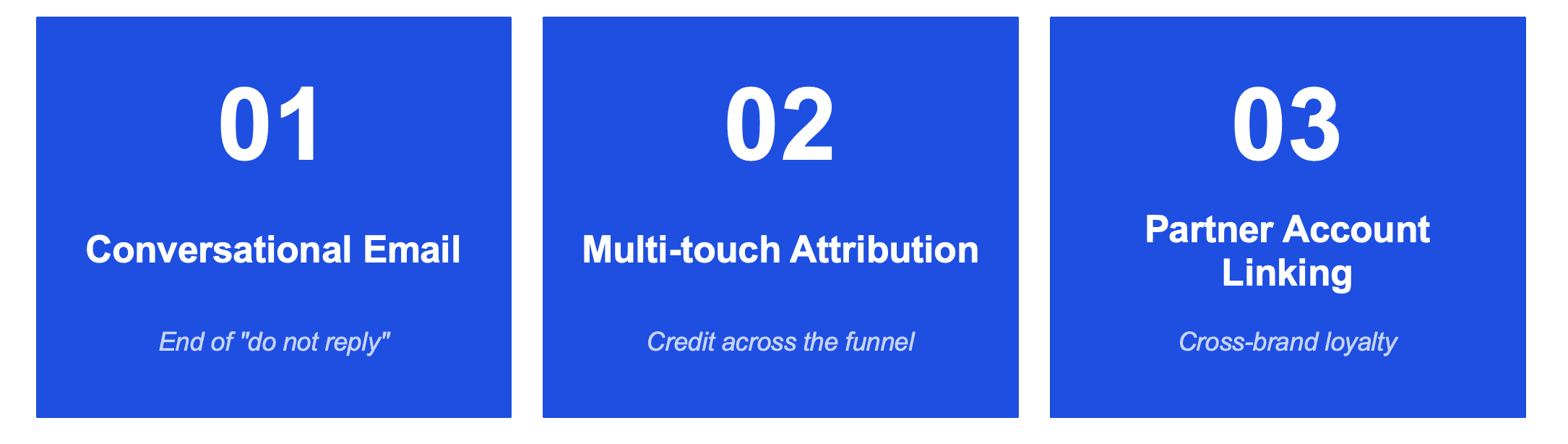
A read on the Salesforce Spring 26 Marketing releaseThe Salesforce Spring 26 release brings three Marketing capabilities that genuinely move the category forward. Conversational Email lets AI agents reply to inbound email in real time. Multi-touch Attribution credits every touchpoint in the buyer journey, not just the last click. Partner Account Linking lets customers connect loyalty rewards across complementary brands. Together they expand what marketing teams can do, the conversations they can have with customers, and the business outcomes they can credibly claim.Three Marketing Features Worth Getting Right. Here Is How to Set Up for Success.Each of these three features unlocks more value when a few operating model questions are answered alongside the technical setup. These are not gating questions. They are the questions that consistently separate organizations that get the most out of a new capability from organizations that get a fraction of it. We work through them with marketing leaders all the time, and the same pattern shows up across industries.Here is the read on each, and what to set up to get the most from them.
Conversational Email: setting up for AI that speaks well as your brand
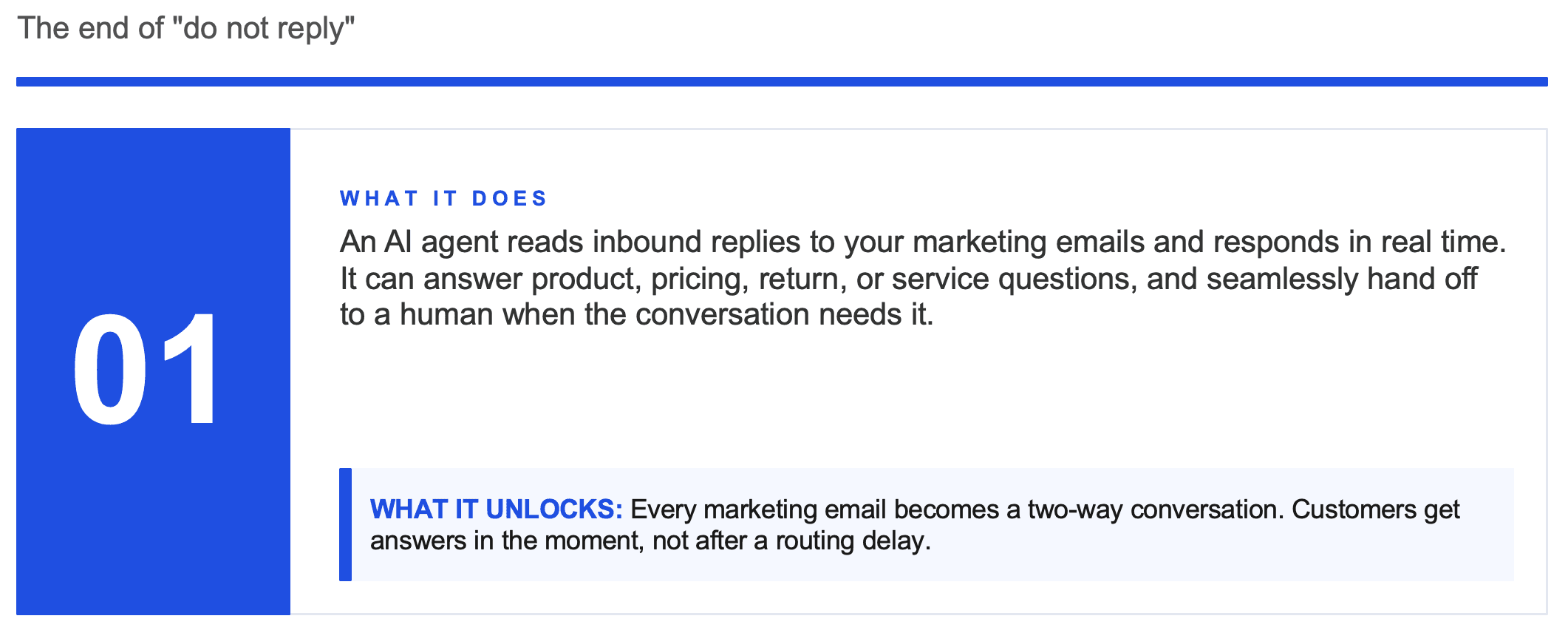
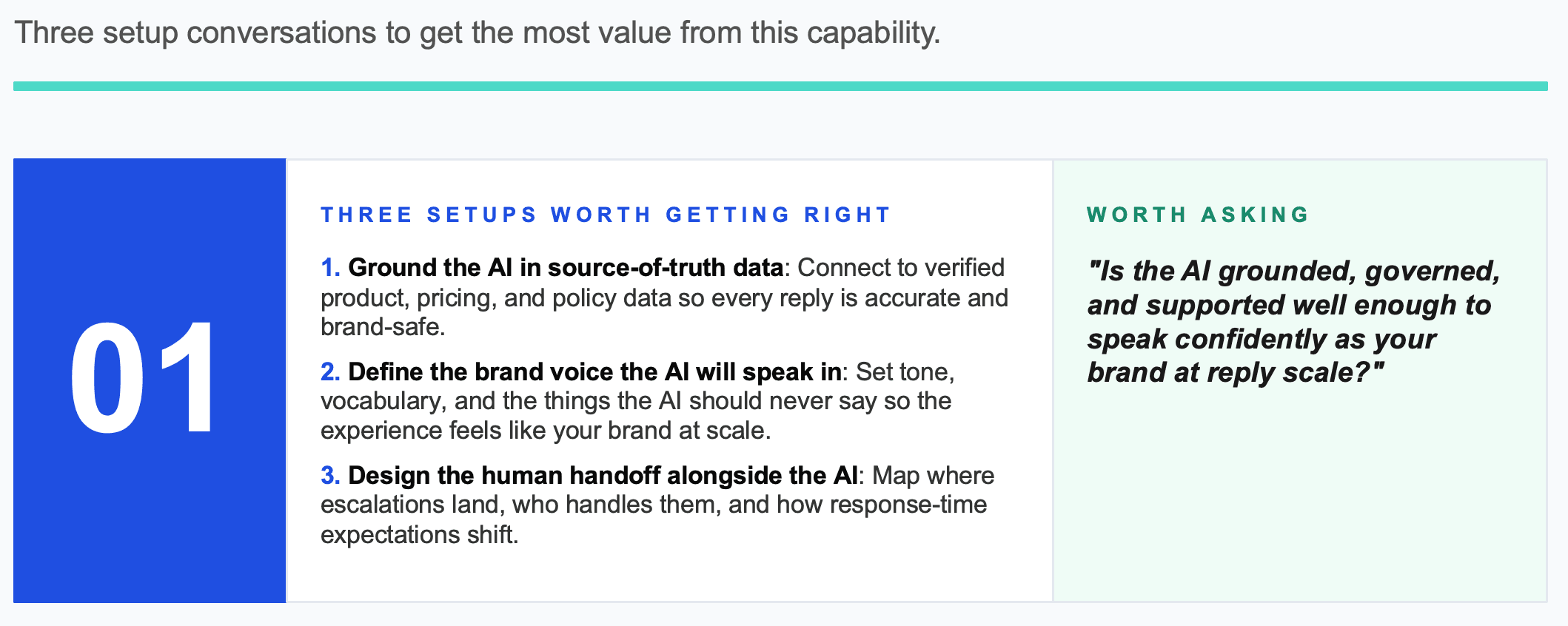
Three Marketing Features Worth Getting Right. Here Is How to Set Up for Success.Conversational Email replaces the do-not-reply pattern with an AI agent that can respond to inbound replies in real time. A customer who replies to a marketing email no longer hits a wall. They get a useful response. For high-volume marketing programs, this turns a one-way channel into a continuous conversation, and that conversation creates engagement, intent signal, and loyalty.To get the most out of it, three setup conversations make a real difference.Ground the AI in your source-of-truth dataThe quality of every AI reply depends on what the AI knows. Connecting Conversational Email to verified product, pricing, and policy data ensures every response is accurate and brand-safe. Organizations that already have a unified customer profile in Data Cloud start ahead. Those that do not get the most leverage from setting that foundation in parallel.Define the brand voice the AI will speak inAI replying at scale is a brand expression, multiplied by thousands of conversations a week. Investing a few cycles upfront to define tone, vocabulary, escalation language, and the things the AI should never say turns a useful feature into a confident brand asset. The teams that do this report higher trust in the system and faster expansion to new use cases.Design the human handoff alongside the AI rolloutThe best AI experiences include a confident handoff to a human when the conversation needs it. Mapping where escalations land, who handles them, and how response-time expectations shift is what makes the full experience feel seamless to the customer. The technology supports this elegantly. The operating design around it is what brings it to life.The question worth asking up front: is the AI grounded, governed, and supported well enough to speak confidently as your brand at reply scale?Three Marketing Features Worth Getting Right. Here Is How to Set Up for Success.
Multi-touch Attribution: setting up to act on what it tells you
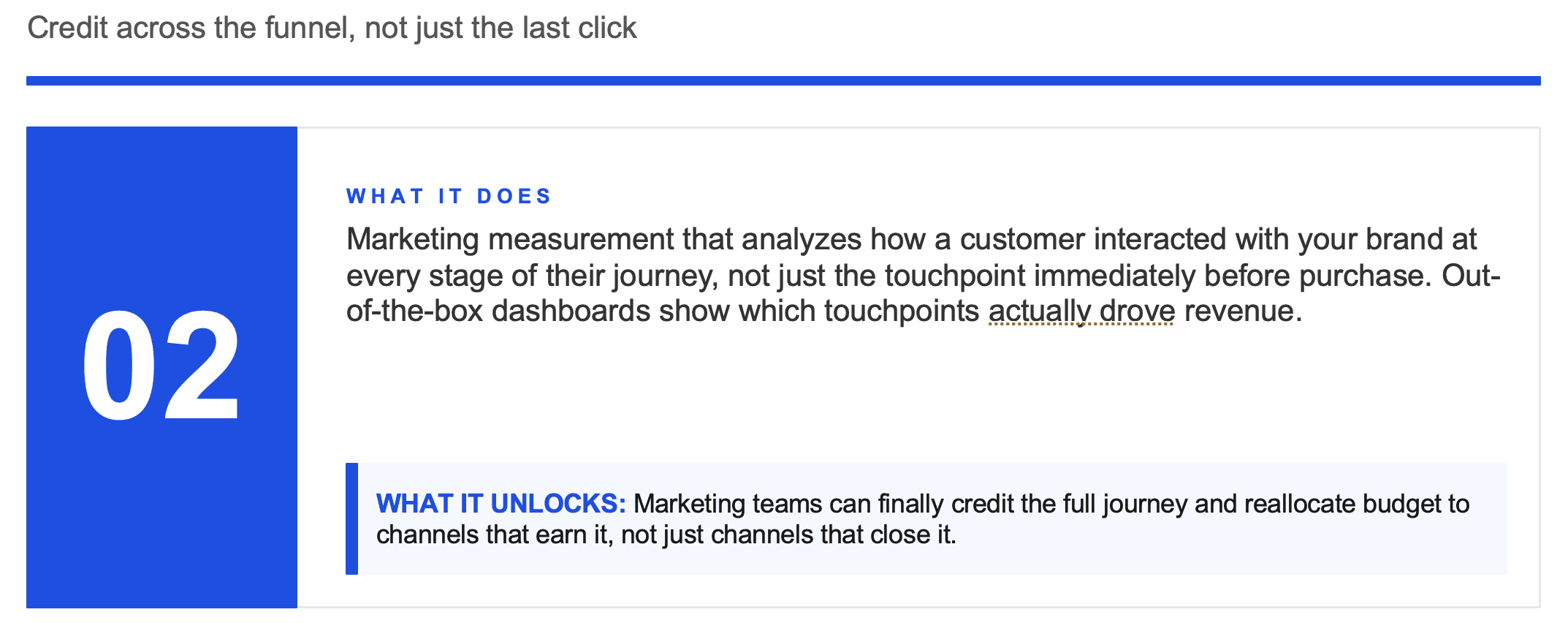
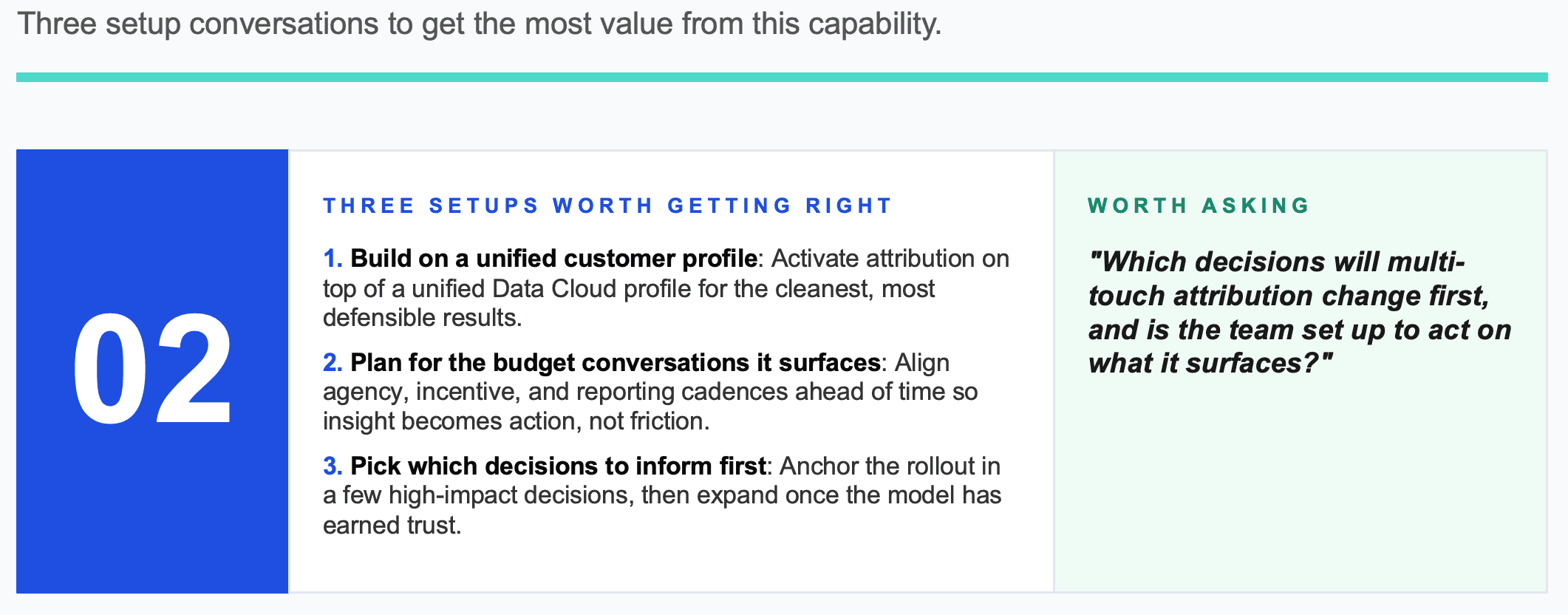
Three Marketing Features Worth Getting Right. Here Is How to Set Up for Success.Multi-touch Attribution moves marketing measurement away from last-click and toward credit across every touchpoint that contributed to a conversion. The marketing community has been asking for this for years, and the out-of-the-box dashboards make adoption straightforward. Used well, multi-touch attribution is one of the most powerful tools a CMO has for telling a credible, complete story about marketing's contribution to revenue.To unlock its full value, three setup conversations are worth having alongside the technical rollout.Build on a unified customer profileAttribution is only as trustworthy as the underlying view of the customer. Organizations that activate Multi-touch Attribution on top of a unified profile in Data Cloud see the cleanest, most defensible results. The investment in identity resolution and profile unification pays off in every downstream marketing decision, and attribution is one of the most visible places that payoff shows up.Plan for the budget conversations the new model will surfaceA richer attribution model often reveals that some channels were under-credited under last-click logic, and others were over-credited. Treating this as good news, the kind that lets the team reallocate spend toward what is actually working, makes the rollout a tailwind rather than a friction point. Aligning agency relationships, internal incentives, and reporting cadences to the new model in advance turns a measurement upgrade into a budget optimization moment.Decide which decisions the model will inform firstAttribution data is most valuable when it is connected to specific decisions. Picking a small number of high-impact decisions to anchor the rollout, such as channel mix, agency briefs, or campaign sequencing, gives the team something concrete to act on from day one. Broader rollout follows naturally once the model has earned trust on the first few decisions.The question worth asking up front: which decisions will multi-touch attribution change first, and is the team set up to act on what it surfaces?Three Marketing Features Worth Getting Right. Here Is How to Set Up for Success.
Partner Account Linking: setting up for shared customer success
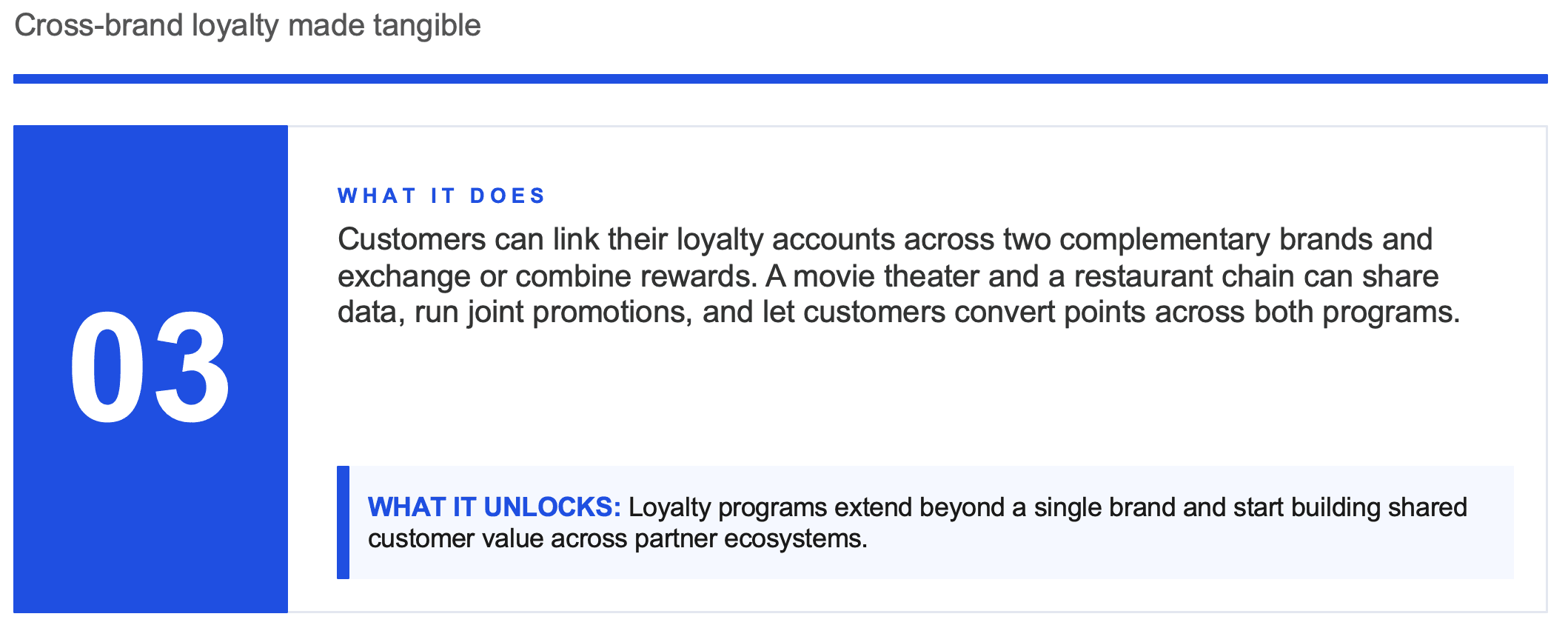
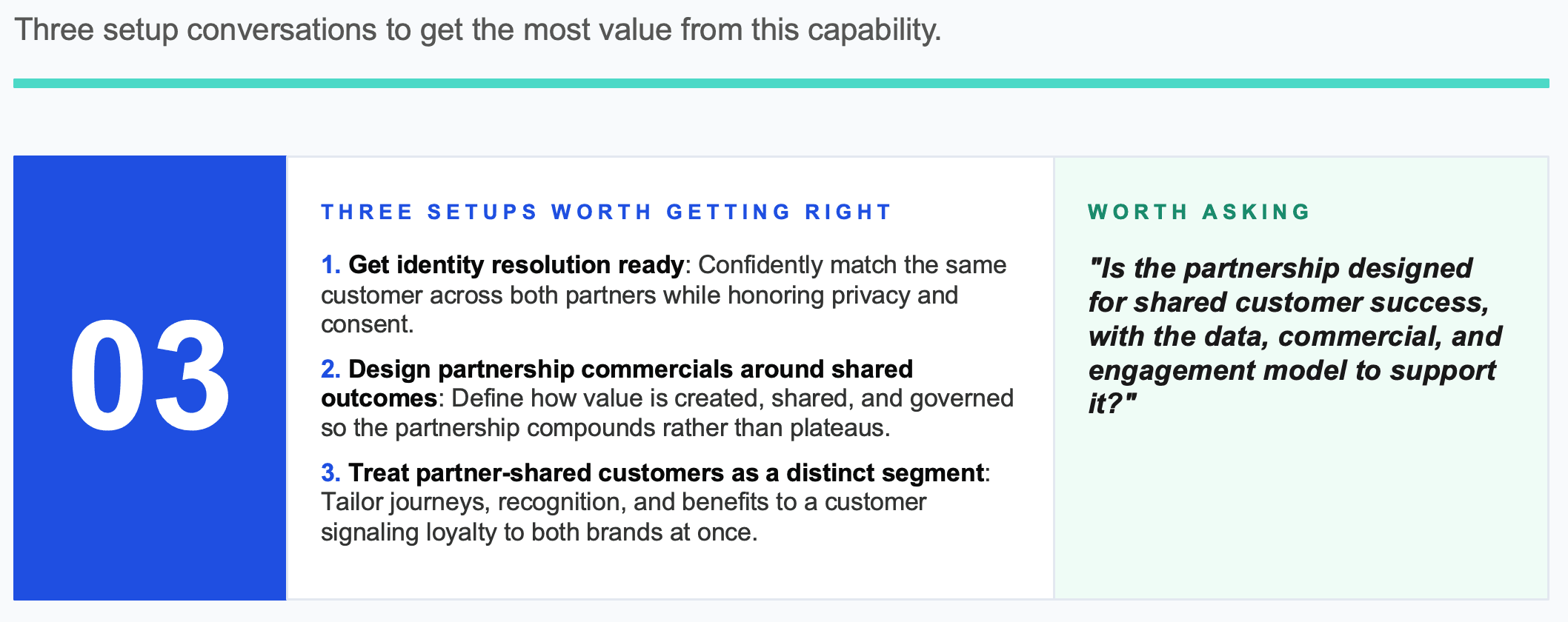
Three Marketing Features Worth Getting Right. Here Is How to Set Up for Success.Partner Account Linking lets customers connect their loyalty accounts across complementary brands and exchange or combine rewards. The Salesforce example of a movie theater and a restaurant chain owning the date-night market is illustrative, and the mechanism is genuinely powerful. Cross-brand loyalty has been a strategy ambition for years. Spring 26 makes the technical foundation tangible.Three setup conversations turn this from a feature into a real cross-brand loyalty engine.Get identity resolution ready for the partnershipCross-brand loyalty depends on confidently matching the same customer across two partners while honoring privacy and consent. Mature identity resolution makes the partnership feel seamless to the customer and trustworthy to both brands. Investing here is what turns a feature activation into a long-term shared asset.Design the partnership commercials around shared outcomesThe most effective cross-brand loyalty arrangements are designed around shared customer outcomes, not just shared promotional spend. Defining how value is created and shared between the two partners up front, including how data is governed and how each brand benefits from the relationship, is what makes the partnership durable. Partnerships built only on cross-promotion tend to plateau. Partnerships built on shared customer success tend to compound.Treat partner-shared customers as a distinct segmentCustomers who link accounts across two brands are giving you a powerful signal: they value both brands enough to want them connected. That is a different kind of loyalty than single-brand membership and deserves a tailored engagement strategy. Designing distinct journeys, recognition, and benefits for partner-shared customers is one of the most under-leveraged opportunities Spring 26 makes possible.The question worth asking up front: is the partnership designed for shared customer success, with the data, commercial, and engagement model to support it?Three Marketing Features Worth Getting Right. Here Is How to Set Up for Success.
The pattern across all three
Each of these three Spring 26 features rewards the same thing: a small amount of setup work alongside the technical configuration, focused on the operating model that surrounds the new capability. The features are ready. The teams that pair them with the right setup conversations consistently see compounding value. The teams that activate without that layer typically see a fraction of what the feature can do.This is the layer the OSF Advisory practice exists to support. The technology is moving fast, and that is a good thing. Our role is to help marketing leaders move at the pace of the technology while keeping the operating model in step. That is what turns a successful release into a compounding business outcome.
How OSF can help
OSF Digital's Advisory practice helps marketing leaders make the most of new Salesforce capabilities by working through the operating model setup alongside the technical activation. We bring a practitioner perspective grounded in years of multi-cloud Salesforce implementation, combined with a strategic lens on what new capability needs to truly thrive. Whether you are evaluating Conversational Email, Multi-touch Attribution, Partner Account Linking, or any of the broader Marketing Cloud Next capabilities now coming on-core, we can help you set up to get the most out of them from day one.Contact OSF Digital to start the conversation.
Sign up for the latest news, trends and insightsSUBSCRIBE
BROWSE AND READFor More On This Topic
Marketing
OSF Digital delivers Salesforce Marketing Cloud solutions for personalization, journeys, analytics, loyalty, and AI-driven growth powered by unified customer data.Read more
Advisory Services
OSF Digital delivers Salesforce advisory expertise across transformation, change, technology, industry, and experience design to drive measurable business growth.Read more
Why Salesforce Data Cloud Is the New Foundation for AI, Personalization, and Revenue Growth
Blog
AI and personalization fail without trusted data. Learn how Salesforce Data Cloud unifies, activates, and embeds data to drive growth.Read more




 Marketing
 Advisory Services
 Why Salesforce Data Cloud Is the New Foundation for AI, Personalization, and Revenue Growth