Ask two commerce leaders how far along they are with AI and you will often get two different answers. One points to a recommendation engine, a service bot, and a merchandising copilot and says the team is well ahead. The other points to the same tools and says the team has barely started. Both can be right, because they are measuring different things, and neither has a shared map to place themselves on. That map matters now, because the distance between “we use AI” and “we are ready for agentic commerce” is wider than it looks, and it does not close by adding more tools.
Two lenses, moving at different speeds
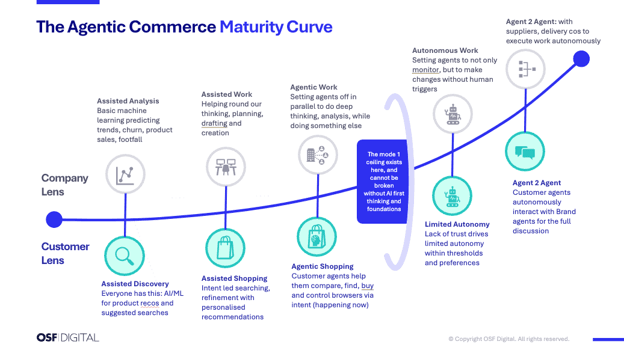
A first piece in this series argued that current commerce operations and agentic commerce run in parallel, not in sequence. This one picks up the more useful question: where exactly are you, and what is the single move that changes your position? There are two lenses to look through. The customer lens is everything a shopper experiences. It runs from assisted discovery, the recommendations and suggested searches almost everyone has, to assisted shopping, intent-led search with personalization, to agentic shopping, where a shopper’s own agent compares, finds, and buys on their behalf, which is happening now. Beyond that sit limited autonomy and, eventually, agent to agent, where a customer’s agent negotiates directly with a brand’s agent. The company lens is everything your own team experiences. It runs from assisted work, where AI helps people think, plan, and draft, to assisted analysis, basic prediction of trends, churn, and demand, to agentic work, where agents run deep analysis in parallel while people do other things, to autonomous work, where agents make changes without a human trigger. Most teams are further along on one lens than the other, and very few have looked at both on purpose. Chart illustrating the Agentic Commerce Maturity Curve with stages from Assisted Discovery to Agent 3.
The ceiling, located
Here is the part worth slowing down for. On both lenses, there is a ceiling, and it sits in the same place: between “assisted” and “agentic.” Everything below the ceiling has one thing in common. A human is still in the loop making the decision, and AI is helping. A better recommendation. A faster draft. A sharper forecast. This is real value, and most of it is still unclaimed. But it is help, not action. Everything above the ceiling is different in kind, not degree. The system does not assist a person. It acts. An agent reads your catalog and answers a shopper before they reach your site. An agent places an order. An internal agent reorders stock without waiting to be asked. You cannot get from below the ceiling to above it by optimizing the tools you already have. The blocker is not effort or budget. It is foundations. An agent that acts needs data it can trust, content it can read, protocols it can use, and governance that lets it move safely. Teams that try to leap without those foundations get fragile demos or risk they cannot control.
Why the lenses are usually out of sync
The imbalance tends to run in a predictable direction. On the customer lens, many teams overestimate where they are. A site search that returns keyword matches is not agentic, even with an AI label on it. If a shopper’s agent cannot read your product data and answer “will this suit my situation,” you are below the ceiling on the customer side, no matter how polished the storefront looks. On the company lens, many teams underestimate where they are. People are already using general AI tools to draft, analyze, and plan, often without anyone calling it a strategy. That is genuine assisted-work maturity, and it is the lowest-risk place to build agentic muscle before a single customer is involved. The practical read: build internal agentic muscle on the company lens first, where the risk is contained, and use what you learn there to cross the ceiling on the customer lens, where the stakes are higher.
What moves you up
Crossing the ceiling is foundation work, not a single launch. Four pieces carry most of the weight, and they line up with the layers from the first blog: the protocols that let agents transact, the content and context that let agents understand your products, the internal agents that build your team’s instinct, and the customer-facing agents that prove competence in public. Governance runs across all four, sized to the risk of each decision rather than applied as a blanket brake. The point of the curve is not to score yourself and feel ahead or behind. It is to stop confusing “we use AI” with “we are ready,” and to see the one jump everything else is building toward.
An honest place to stand
No one is at the top of this curve yet. Agent to agent commerce, where your agent negotiates with a customer’s agent end to end, is real but early. Agentic shopping on the customer side is here today. Assisted work on the company side is nearly universal. The teams getting ahead are not the ones claiming the furthest position. They are the ones who placed themselves honestly on both lenses, found their ceiling, and started building the foundations to cross it.
How OSF Can Help
OSF works with commerce organizations to place themselves honestly on the agentic commerce maturity curve and build the foundations that cross the ceiling, on Salesforce. We help you keep extracting value from your current platform while preparing the data, content, protocols, and governance that agentic commerce depends on. Contact us to map where you are today and what the next move looks like.
Sign up for the latest news, trends and insightsSUBSCRIBE
BROWSE AND READFor More On This Topic
The Framework for the Agentic Enterprise: Moving from Manual Tasks to Deterministic Workflows
White Papers
Most enterprises have the systems. They are still missing the execution. This whitepaper lays out what it takes to move from shadow processes to autonomous, auditable workflows and why the window to act is narrowing.Read more
The Agentic Enterprise: Rewriting the Operating System of Business
White Papers
AI is no longer just assisting work — it’s executing it. This whitepaper explores how intelligent applications and autonomous agents are closing the execution gap, enabling organizations to move from strategy to action at the speed of intent.Read more
Building AI Operations: A Practical Guide for B2B and B2C
Blog
Build smarter AI operations. Learn how clear goals, strong data, and human AI collaboration help brands scale AI from pilot to real impact.Read more




 The Framework for the Agentic Enterprise: Moving from Manual Tasks to Deterministic Workflows
 The Agentic Enterprise: Rewriting the Operating System of Business
 Building AI Operations: A Practical Guide for B2B and B2C